

Gluten-Free Pizza Bites
There is a specific thing a kid wants at four in the afternoon, and it comes out of the freezer in a yellow box. If you are gluten-free, that box does not exist. Not in the freezer aisle, not at the store, not online.
These take about twenty minutes and they are better anyway. A soft dough made from three things, a piece of mozzarella pressed into the middle, and eight minutes in an air fryer. They come out golden on the outside with cheese pulling when you tear one open.
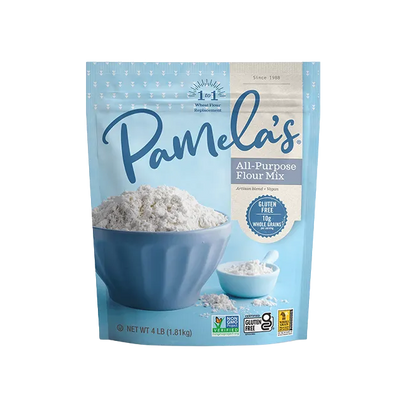
The dough is the part people are surprised by. Pamela's 1:1 All-Purpose Flour, baking powder, and Greek yogurt. No yeast, no rising, no waiting. You stir it together and it is ready.
Make a double batch and freeze them. They reheat straight from frozen, which is the whole point of the thing in the yellow box. So good, no one will guess they are gluten-free, the way Pamela's has done it since 1988.
Are There Gluten-Free Pizza Bites You Can Buy?
No, and that is not for lack of looking. There are no gluten-free pizza bites or pizza rolls in the freezer aisle, not from the major frozen brands and not from the gluten-free specialty ones.
The problem is the dough. Frozen pizza bites rely on a dough that can be machine-rolled thin, sealed around a filling, and frozen without cracking. That is difficult enough with wheat and genuinely hard without it, which is why nobody has brought one to market.
At home it takes twenty minutes. Pamela's 1:1 All-Purpose Flour with baking powder and Greek yogurt makes a soft dough that wraps around cheese and air fries golden.
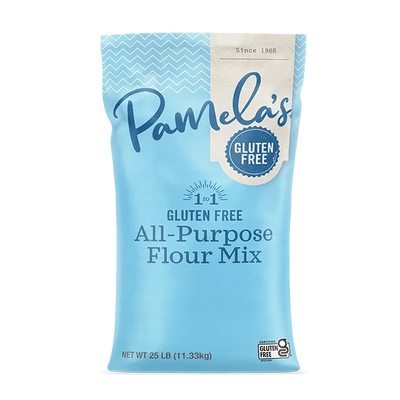
The flour these are built on Pamela's Gluten-Free 1:1 All-Purpose Flour Rice-based, finely milled, nut-free, and bound with guar gum rather than xanthan. Substitutes one for one for wheat flour. GFCO-certified.
And they freeze, which is the part that matters. Make a double batch, freeze them raw, and air fry from frozen whenever someone wants one.
The Three-Ingredient Dough
Flour, baking powder, and Greek yogurt. That is the whole dough, and it takes about two minutes.
This is a version of the two-ingredient dough that has been going around for years, where self-rising flour and Greek yogurt make a quick pizza or bagel dough with no yeast. Gluten-free flour has no leavening in it, so the baking powder goes in separately.
Use full-fat plain Greek yogurt. Nonfat makes a stickier, slacker dough, and the fat matters for tenderness. Regular yogurt is too thin and will not hold together.
Do not substitute sour cream. Similar texture, much more acid, and the dough tastes of it.
The dough should feel soft and slightly tacky, not sticky. If it clings to your hands rather than pulling away cleanly, work in a tablespoon of flour at a time. Go slowly, since too much flour makes it crack when you try to wrap it.
A teaspoon of olive oil worked in at the end makes the dough more pliable and easier to shape. Worth it.
How to Stuff Them Without the Cheese Escaping
This is the part that decides whether you get pizza bites or a tray of melted cheese.
Use a small piece of mozzarella, not a pile of shreds. A cube cut from a block, about half an inch, behaves far better than loose shredded cheese. Shreds work their way into the seam and leak.
Flatten the dough in your palm, about two inches across, thicker in the middle than at the edges.
Put the cheese in the center and bring the edges up around it, pinching firmly to seal. Pinch more than feels necessary. The seal is the only thing holding the cheese in.
Roll it between your palms to smooth the seam, and set it seam side down.
Do not overfill. More cheese is tempting and it is the single most common reason these burst. A half-inch cube is right.
Six large bites from one batch, or twelve smaller ones if you want them more two-bite sized. A larger bite gives you a better cheese pull. A smaller one is easier to hand to a kid. Double the batch if you are feeding a crowd, since six disappears fast.
If the dough cracks while you are wrapping, it is too dry. Work in a teaspoon of yogurt or olive oil.


