



Gluten-Free Biscuits and Gravy
Ask people what they miss most after going gluten-free and biscuits and gravy comes up more than almost anything. It is not a fancy dish. It is a plate of soft bread under peppery sausage gravy, and it is the thing that used to be on every diner table in America.
The gravy is the part that stops people, not the biscuits. Sausage gravy is built on a roux, a roux is built on flour, and most gluten-free flours either turn gluey or refuse to thicken at all.
A one-to-one gluten-free flour blend thickens a roux the way wheat flour does, measure for measure, no adjusting. That is the whole fix, and almost nobody explains it. The biscuits, meanwhile, are a pouch of mix and a cup of cold water.
The whole plate takes about thirty minutes, most of which is the gravy simmering while the biscuits bake. So good, no one will guess they are gluten-free, the way Pamela's has done it since 1988.
How to Thicken Gluten-Free Gravy
Use a one-to-one gluten-free flour blend, and use it exactly like wheat flour. That is the short answer, and it is the one most people are looking for.
The ratio is the same one you would use with wheat: about 1/4 cup of flour to 2 1/2 cups of milk, whisked into the rendered fat and cooked for a minute before the liquid goes in. No adjusting, no extra binder.
What to look for in a blend. Finely milled matters more than anything else, because a coarse grind leaves a grainy texture that never quite cooks out. Rice-based blends work well. Bean-based blends do not, since they carry a flavor that has no business near sausage. And avoid single-ingredient flours like coconut or almond, which do not thicken a roux at all.
Cook the roux before adding milk. Sixty seconds of the flour bubbling in the fat is what takes the raw taste out. Skip it and the gravy tastes like flour no matter how long you simmer it.
What about cornstarch? It works and it is not the same thing. Cornstarch makes a glossy, slightly slick gravy that sets firmer as it cools, and it has to go in as a slurry at the end rather than as a roux at the start. Sausage gravy is supposed to be opaque and soft, and a flour roux is what gets you there.
Arrowroot and tapioca have the same issue as cornstarch, with a stringier texture. Fine for a pan sauce, wrong for this.
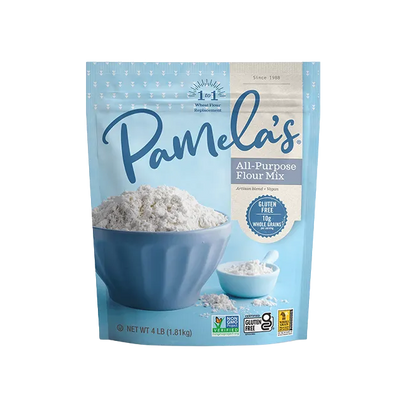
We make one if you need it: Pamela's 1:1 All-Purpose Flour is rice-based and finely milled. But any blend meeting the description above will do the job, and the technique matters more than the brand.
The Biscuits Take Two Ingredients
A pouch of Pamela's Buttermilk Drop Biscuit Mix and one cup of cold water. No rolling, no cutting, no cold butter to work in.
Drop biscuits are the right shape for gravy, which is convenient. A craggy top has more surface for the gravy to catch, and the softer crumb soaks it up rather than sitting under it.
Use cold water. The fat in the mix needs to stay solid until it hits the oven, where it turns to steam and lifts the biscuit. Warm water melts it early and you lose the flaky top.
Stop mixing while the dough still looks shaggy, about fifteen stirs. Overmixing is the most common reason biscuits come out flat.
Bake at 425 degrees F for 14 minutes. They can go in while the gravy simmers, and both finish at about the same time.


