



Gluten-Free Banana Pancakes
There are two ways to get banana into a pancake. You can mash the bananas and fold them in, which leaves streaks of fruit and pale patches of batter and a few stubborn lumps that never quite break down. Or you can put everything in the blender, which is what this recipe does, and end up with a smooth golden batter that tastes like banana all the way through. Blending also means those blackened bananas in the freezer are exactly as good as fresh ones, maybe better. The batter comes together in about five minutes, it will look thicker than you expect, and that is on purpose. Cook them low and slow and they turn out tender, faintly caramelized at the edges, and sweet enough that syrup is optional. So good, no one will guess they are gluten-free, the way Pamela's has done it since 1988.
Why You'll Love These Banana Pancakes
- Banana flavor in every bite. Blending distributes the fruit evenly instead of leaving pockets of it.
- Frozen bananas work perfectly. Thaw and blend. No mashing, no stringy bits.
- Five minutes of prep. Everything goes in one blender jar.
- No lumps to work around. The blender does what a whisk cannot on gluten-free batter.
- Sweet enough to skip the syrup. Ripe bananas do most of the work.
Why the Blender Makes Better Banana Pancakes
Mashing a banana with a fork gets you maybe 80 percent of the way there. What is left is fiber, and it shows up as stringy streaks in the finished pancake and as the occasional dense lump that never cooked through. Blending breaks the fruit down completely, so the banana becomes part of the batter rather than something suspended in it.
There are two more reasons it helps here specifically.
Gluten-free batter benefits from the extra mixing. With wheat batter you stop stirring early to avoid developing gluten. There is no gluten to develop in Pamela's Pancake & Baking Mix, so blending until smooth costs you nothing and gets the starches fully hydrated, which is what keeps the centers from turning gummy.
Frozen bananas become an asset. Thawed bananas release a lot of liquid and go slippery, which makes them miserable to mash and easy to blend. If you keep a bag of overripe bananas in the freezer, this is the recipe for them. Thaw them fully, liquid and all, and pour the whole thing in.
The batter will look too thick. That is correct. Between the mix and the banana puree it should be noticeably thicker than a standard pancake batter. Scrape the sides of the jar with a spatula between pulses rather than adding liquid to loosen it. Thinning the batter is the most common way to end up with flat pancakes here.
The Best Gluten-Free Mix for Banana Pancakes
The best gluten-free mix for banana pancakes is one with its own leavening and enough binding to hold up to a cup of fruit puree, which is a heavier load than a standard pancake batter carries.
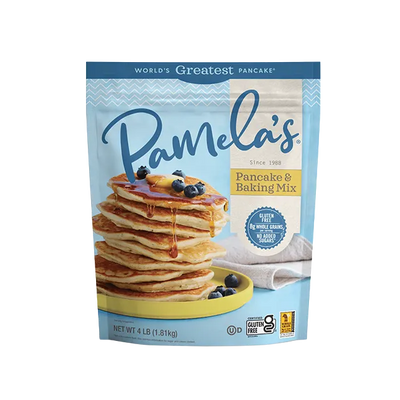
This is where a lot of gluten-free banana pancakes go wrong. Adding three-quarters of a cup of blended banana to a batter means adding moisture, sugar, and weight all at once. A thin or under-bound mix cannot support that and you get pancakes that are dense in the middle and refuse to set. Pamela's Pancake & Baking Mix is built for it: it is already leavened, and the almond meal and cultured buttermilk in it give the batter body and a slight tang that plays well against the sweetness of ripe fruit.
The mix these are built on Pamela's Gluten-Free Pancake & Baking Mix Leavened, ready to go, and the base for pancakes, waffles, biscuits, and a good deal more. GFCO-certified.
If you are adapting a wheat banana pancake recipe, the swap is not always one to one. Start by replacing the flour with an equal amount of the mix, then remove any baking powder, baking soda, and salt the original called for, since the mix already contains them. Expect the batter to want slightly more liquid than the wheat version did.
How Ripe Should the Bananas Be?
Very ripe. Heavily speckled, mostly brown, soft enough that the peel splits when you press it. A yellow banana with a few freckles will work but the pancakes will be noticeably less sweet and less fragrant, and you will taste the difference immediately.
The starch in a banana converts to sugar as it ripens, which is why an overripe banana tastes like candy and an underripe one tastes like a vegetable. For this recipe you want that conversion as far along as it will go.
Two or three bananas, about 3/4 cup blended. Banana sizes vary enough that the volume is the number to trust. Two large bananas usually get there, three small ones sometimes do not.
No ripe bananas and no patience? Bake unpeeled bananas on a sheet pan at 300 degrees F for 15 to 20 minutes, until the skins are fully black and glossy. Cool them, then squeeze the fruit out. It is not identical to true ripening, since it develops the sugars without developing the same aroma, but it is a good deal closer than a yellow banana.
Can You Make Banana Pancakes With Just 3 Ingredients?
You can, but they will not be pancakes in the way you are picturing. Three-ingredient banana pancakes are typically banana, egg, and a little baking powder, and with no flour in the batter there is nothing to build structure. They cook up thin and custardy, they taste distinctly of egg, and they tear when you try to flip them. They are much closer to a crepe or a small omelet than to a stack of pancakes.
The same goes for the flourless and one-banana versions. What flour actually does in a pancake is trap the gas from the leavening so the pancake rises and sets into something tender and sliceable. Remove it and there is nothing holding the air.
If what you want is a fast, low-effort breakfast, the honest answer is that a mix gets you there faster than a workaround does. This recipe is five minutes of blending, and it produces pancakes that stack, hold syrup, freeze well, and do not taste like eggs.
If what you want specifically is a grain-free breakfast, banana and egg is a reasonable thing to eat. Just go in knowing it is a different food, and cook it in a small nonstick pan at low heat in pancakes no wider than three inches, which is the only way they hold together.
What These Pancakes Contain
These pancakes contain wheat-free gluten-free grains, egg, dairy, and tree nuts.
The dairy and tree nuts come from the Pancake & Baking Mix itself, which contains almond meal and cultured buttermilk. That is true no matter what else you change, so these pancakes cannot be made nut-free or dairy-free by swapping the milk. The recipe adds an egg, plus milk and butter on top of what is in the mix. The optional walnuts add more tree nut.
That also means these are not vegan and cannot be made vegan, even using an egg substitute and a plant milk.
The mix is produced on equipment that also processes soy.
Everything from Pamela's is certified by the Gluten-Free Certification Organization, and it is made in a certified gluten-free, peanut-free facility.


